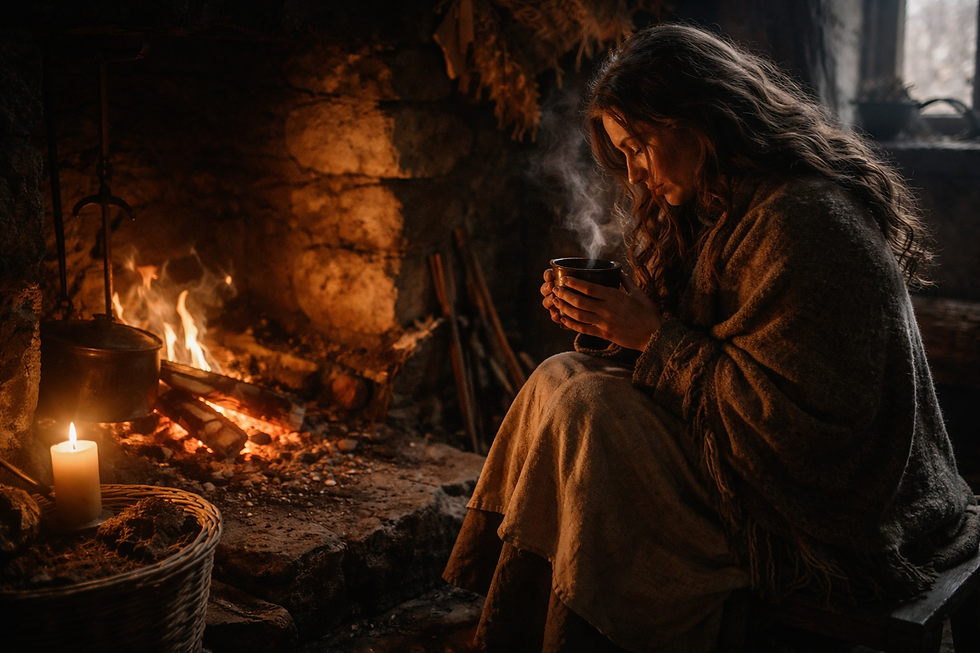
The Gathering of the Last Light — A December Witch’s Charm
- Sorcha Lunaris

- Dec 5, 2025
- 5 min read
“Even a fading sun leaves power in its wake.”

The first week of December has always held a quiet peculiarity in the Irish year — a soft turning of the sky, a subtle sinking of the day, a sensation that the world is drawing breath before the darkest stretch of winter. It is a time when the land feels bare yet expectant, when frost sharpens the hedges and the sun slips quickly behind distant hills, leaving a pale, golden wash across the world. This moment, fleeting but potent, gave rise to one of the gentlest workings in the old craft: The Gathering of the Last Light.
Unlike the bold fire rituals of high festivals or the deep rites of winter solstice, this practice was understated. It belonged not to ceremony, but to instinct. Witches, wise folk, and those attuned to the shifting seasons understood that the last light of early December held a quality unlike any other in the year. They described it as the light of transition — not bright enough to blind, not warm enough to strengthen the body, yet luminous enough to prepare the spirit. It was the light that stood on a threshold, neither belonging entirely to autumn nor yet surrendered to winter.
In the countryside, older people spoke of this light as the “soft gold,” the “weak fire,” the “quiet warmth,” and in some districts, the “tipping sun.” They believed that it was in these dimming rays that the year revealed its wisdom: what needed to be released, what could be carried forward, and what was meant to rest in the dark. And so the witch stepped outside at this hour, not with tools or offerings, but simply with attention.
The power of this practice lay in its humbleness. A witch did not grip the light. She did not call it, trap it, or command it. She received it — arms open, heart steady, mind quiet. She understood that the last light needed no crafting. Its magic lay in the fact that it was disappearing. It taught her how to let what is passing flow across her, through her, and into memory without fear.
For in the old craft, the early December light was not seen as weak; it was seen as wise. Light in decline sees the world in a different way — angled low, touching edges, outlining what remains. It shows the contours of stones, the shadows of trees, the shapes of fences, and the thin outline of the witch’s breath in the air. It makes visible the bones of the land, and in doing so, helps the witch recognise the bones of her own truth.
This is why the Gathering of the Last Light is not sun magic. It is transition magic — the art of stepping into winter with clarity rather than fear, with endurance rather than resistance, and with a heart that honours what is fading rather than clinging to what cannot remain.
When the sun lowers its gaze upon the early December sky, the witch answers with her own.
The Witch Stands at the Edge of Day
To perform this practice, the witch waits for a particular moment — that fragile minute when the sun is sinking but not yet gone, when the world is washed in an amber tone that feels both tender and solemn. It is not the glamour of sunset, nor the hush of dusk. It is the breath between them: the last light, the final warmth, the quietest fire of the year.
Want to read more?
Subscribe to theancientirishcraft.com to keep reading this exclusive post.