The Listening of Small Disturbances — Irish Divination at the End of January
- Sorcha Lunaris

- Jan 22
- 7 min read
Updated: Apr 7
“What interrupts you now is asking to be understood.”
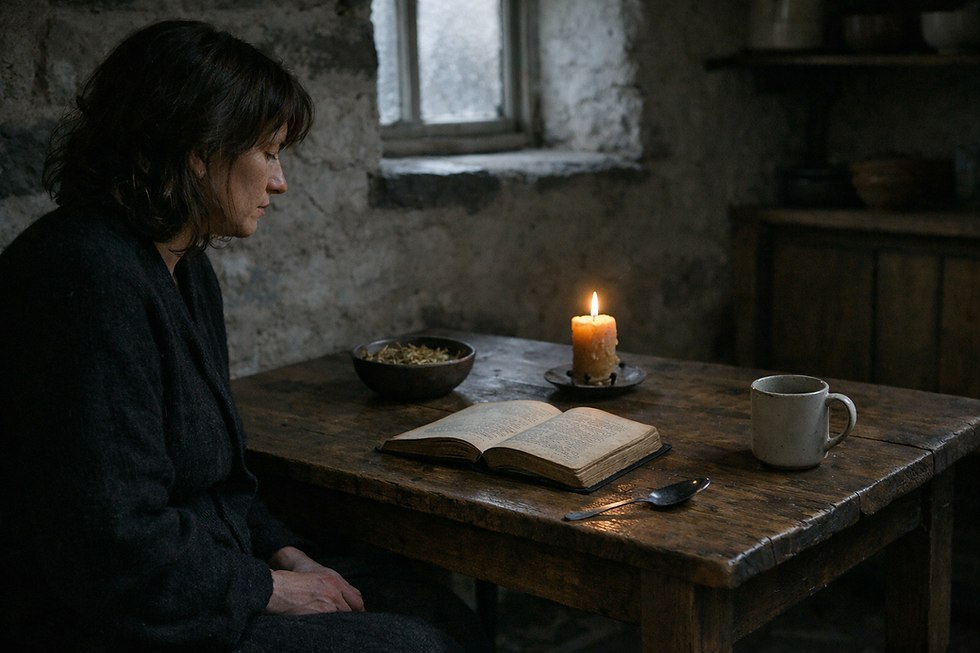
In the final days of January, within a contemporary Irish witchcraft sensibility, one may turn not always toward formal divination or structured acts of seeking, but toward the small disturbances of ordinary life — moments when rhythm breaks rather than flows. A dropped object, an unexpected sound, a repeated interruption of thought, or a sudden change in weather need not be dismissed as meaningless. These disturbances matter precisely because they unsettle what has become habitual and automatic. When routine falters, it creates a brief opening where awareness can return to places it has quietly abandoned, revealing what has been carried without reflection.
This moment in the seasonal year may be understood as a narrowing rather than a turning. January is almost complete, yet February has not yet claimed authority over the days. The land reflects this in-between state through restraint rather than movement. Irish seasonal understanding suggests that during such periods, the year does not communicate through dramatic signs or clear omens. Instead, it presses gently against awareness through interruption. What disrupts the flow of the day may signal where attention has grown thin, distracted, or misaligned with the season’s quieter demands.
These disturbances need not be interpreted as warnings, punishments, or misfortune. They are better understood as neutral signals, offering information rather than judgement. The year, still young but no longer tentative, may seem to test attentiveness at this stage. What breaks concentration or rhythm points toward something unresolved beneath the surface — an unfinished matter, an unsustainable pace, or a subtle resistance to what lies ahead. Within contemporary Irish witchcraft, this may be approached as an opportunity rather than a problem. Correction offered early requires far less effort than adjustment forced later.
The Listening of Small Disturbances belongs especially to this closing stretch of January because it requires no preparation, tools, or intentional questioning. The witch does not seek messages; she receives them. By remaining receptive to interruption, she allows the year to indicate where awareness needs to return before forward momentum resumes. This helps ensure that what crosses into February does so with fewer hidden tensions. Attention, rather than action, becomes the primary work of this moment, grounding the witch before the year asks for movement again.
Divination Through Interruption
The Listening of Small Disturbances may be approached as a form of divination that requires no tools, no casting surface, and no formal question. Its purpose is not to reveal what will happen, but to illuminate what has been overlooked. Within a contemporary Irish witchcraft framework, what interrupts repeatedly is rarely treated as meaningless. Instead, it marks unfinished attention — places where awareness has slipped, pacing has become misaligned, or something quietly resists being carried forward. This divinatory practice operates through correction rather than prophecy, returning the witch to the present moment so alignment can be restored before the year asks for greater movement.
Meaning in this practice does not arise from a single interruption taken in isolation. A dropped object or sudden noise is not automatically significant. Insight emerges through pattern, repetition, and inner response over time. The witch observes what keeps recurring and how it affects her — irritation, distraction, unease, or avoidance may all be considered part of the message. These responses reveal where attention is strained or divided. In this way, the disturbance becomes a mirror rather than a symbol, reflecting internal misalignment rather than offering an external sign to interpret.
Late January may be regarded as especially sensitive to this kind of divination because the year is preparing to shift again. Anything unresolved risks being carried forward into February, when momentum will increase. Small disturbances function as final messengers, quietly indicating where attention must return before progress resumes. To ignore them is not necessarily dangerous, but it is often inefficient. The Ancient Craft values economy of effort. Addressing misalignment while it remains subtle requires far less energy than attempting to correct it once it has hardened into resistance later in the year.
This divination does not predict outcomes or offer reassurance. It refines orientation. Rather than expanding vision outward, it narrows focus inward, asking the witch to notice what interrupts her flow. By listening carefully, she allows the year to recalibrate its course without force or confrontation. Interruption becomes instruction, and attention becomes the primary tool of divination. In this way, the Listening of Small Disturbances supports clarity through humility, ensuring the witch moves forward with fewer unseen tensions shaping her path.
Why the End of January Reveals Friction
Want to read more?
Subscribe to theancientirishcraft.com to keep reading this exclusive post.