


Practising Without a Dedicated Ritual Space — The Living Craft
- Sorcha Lunaris

- Mar 25
- 10 min read
“What is used with intention does not need to be set apart forever.”
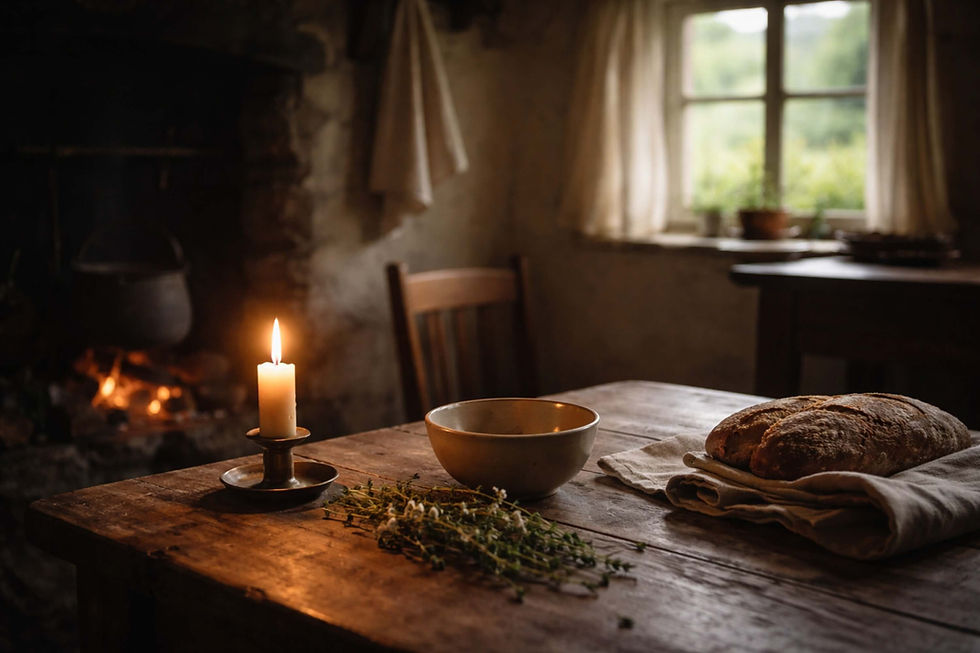
In older folk practice, there was rarely a fixed ritual room or permanent altar separated clearly from the rest of daily life. Magic was more often woven into the spaces people already used and knew well: the hearth, the doorway, the bedside, the yard, the path beyond the threshold, or the table where ordinary tasks were done. These places mattered not because they had been permanently set aside, but because they had become familiar points of use, attention, and meaning. A blessing spoken at the door carried force because the door marked passage. A protective act near the bed mattered because sleep left a person vulnerable. In this way, older practice did not require distance from life in order to become real. It worked through the life already being lived.
This reflects an important truth within Irish witchcraft sensibility. Sacredness was often understood through relationship and repeated use rather than through formal separation alone. A place became meaningful because it was returned to with purpose, not necessarily because it remained untouched by everyday activity. The Ancient Craft recognises that the ordinary world already contains thresholds, centres, edges, and points of spiritual usefulness. The kitchen may hold nourishment and transformation. The doorway may hold passage and protection. The corner of a room may offer enough stillness for focused intention when approached in the right spirit. In that sense, practice without a dedicated ritual space is not a lesser form of working. It is often closer to the older logic in which magic and life were not sharply divided from one another.
Modern expectations can make this easy to forget. There is often an impression that proper practice requires a permanent altar, a private room, or a visually recognisable sacred setting in order to feel complete. Yet many witches live in shared homes, busy households, rented spaces, or environments where privacy and permanence are not always possible. The Living Craft speaks directly to this reality by refusing the idea that depth depends upon having one fixed place in which to work. What matters more is the quality of presence brought to the moment. A space used briefly but attentively may hold more truth than a larger one approached without inward focus. The absence of a dedicated room does not prevent the work. It simply asks the witch to understand place in a more flexible and embodied way.
Practising without a dedicated ritual space can be understood as a discipline of adaptability rather than a compromise. The witch learns to recognise what kind of meaning a place already holds and to work with that meaning rather than waiting for ideal conditions to appear. This often deepens the practice because it strengthens the ability to carry awareness into ordinary life instead of confining the Craft to one protected corner. The space does not create the magic by itself. The witch brings the intention, the steadiness, and the right use that allow the moment to become spiritually alive. In this way, the older lesson remains clear. The Craft was never confined to one place because the world itself already offered many places in which sacred work could be rightly done.
Why Adaptability Can Deepen the Practice
Practising without a dedicated ritual space teaches the witch to rely less on fixed arrangement and more on the steadiness she is able to bring into the place she is actually in. This is an important distinction. When practice depends too heavily on one specific setting, it can become easy to feel disconnected whenever that setting is unavailable. Older Craft wisdom tends to resist that dependence. It suggests that the strength of the work lies not only in where it happens, but in whether the witch can recognise the right use of the space before her. A quiet chair by a window, a threshold crossed with intention, or a table cleared for a short while may all become sufficient when approached with presence. Adaptability in this sense is not dilution. It is a form of spiritual competence.
This matters because real life rarely remains perfectly arranged for practice at all times. Homes are shared, schedules shift, privacy comes and goes, and the conditions of daily life do not always permit permanence. The Living Craft acknowledges this honestly. It does not ask the witch to postpone meaningful work until a more ideal setting appears. Instead, it teaches her to notice where focus can still be gathered, where intention can still be held, and where the ordinary shape of the day already offers a usable threshold. The Ancient Craft has always carried something of this practicality. Magic was not reserved only for moments of perfect quiet or visual order. It was worked where life was already unfolding, and that gave the practice a resilience many modern assumptions fail to recognise.
There is also a deeper discipline within this adaptability. When a witch cannot rely on one permanent place, she learns to create coherence through repeated inner habits rather than through external arrangement alone. She becomes more aware of how she begins, how she settles herself, what signals transition into focused work, and how intention is gathered before action starts. These things matter because they create continuity even when the surroundings change. A dedicated space can support practice, but it is not the only thing that can do so. Repeated gestures, familiar tools, a certain order of action, or the simple act of pausing and marking the moment inwardly can all help establish a sense of sacred work. In this way, the lack of permanence may actually strengthen the witch’s deeper foundations.
Adaptability should not be mistaken for spiritual compromise. In many cases, it creates a more integrated and mature relationship with the Craft. The witch learns that magic does not disappear when the room changes, the altar is packed away, or the household remains active around her. It continues because she has learned how to bring steadiness into the place she occupies rather than waiting for the place to provide everything for her. This makes the work more portable, but also more honest. It shows whether practice is truly alive within the witch herself or whether it has become too dependent on outer arrangement. The Living Craft values this kind of learning because it returns the witch to a quieter truth: sacred work remains possible wherever intention, attention, and right use can still be brought together.
How Everyday Places Become Spiritually Usable
One of the deeper teachings within this practice is that everyday surroundings already contain forms of meaning the witch can work with if she learns to notice them properly. A doorway is not only an entrance. It is a threshold. A table is not only a surface. It can become a place of preparation, blessing, or focused action. A bedside is not only where sleep happens. It may also be a place of protection, reflection, or quiet inner work. The Ancient Craft recognises these layers because older folk practice rarely needed a place to become visually separate before it could become spiritually useful. Meaning arose through use, symbolism, and relationship. In that sense, an ordinary place does not need to become something entirely different. It needs only to be met with clearer understanding of what it already holds.
This changes how the witch reads her environment. Instead of asking whether a space looks sacred enough, she begins to ask what kind of work naturally belongs there. A kitchen may support nourishment, healing, or household blessing. A window may become a point of watching, speaking intention outward, or marking the relationship between the inner home and the wider world. A path just outside the door may carry significance for transition, departure, or the movement from one condition into another. When a witch works in this way, the space does not need to imitate a ritual room in order to be valid. It already possesses a structure of meaning. What matters is whether that meaning is recognised and used with care. This is one of the reasons the Living Craft remains so practical and so enduring.
There is also a kind of humility in this approach. It does not demand that every act of magic take place in a specially prepared environment removed from ordinary life. Instead, it asks the witch to meet life where it already is and to understand that spiritual depth can exist within ordinary surroundings if she knows how to enter them rightly. This often makes the practice feel more lived and less performative. The work becomes woven into the real conditions of the day rather than reserved only for ideal moments. Within Irish witchcraft, this matters because the older sensibility has long favoured relationship over display. A place becomes spiritually alive not because it has been made impressive, but because it has been approached with steadiness, repeated care, and the right use for the need at hand.
Practising without a dedicated ritual space can actually deepen the witch’s sensitivity to place. She becomes more attentive to atmosphere, function, and the quiet symbolic logic already present in her surroundings. A corner, a doorway, a chair, a threshold, a small patch of earth, or the edge of a bed may all begin to reveal themselves differently once she learns to see them through the eyes of the Craft. This does not make every place equal in purpose, but it does make more places available to meaningful work than modern assumptions often allow. The Living Craft teaches that spiritual usefulness is not confined to what has been permanently designated. It often appears wherever the witch can recognise the deeper shape of the place before her and meet it with intention.
Carrying the Craft into Real Life
For the modern witch, practising without a dedicated ritual space becomes an important lesson in how the Craft is actually lived rather than merely arranged. Many people wait for ideal conditions before allowing their practice to deepen: more privacy, more room, more quiet, more permanence, more visual order. Yet life does not always provide these things in stable form. The Living Craft answers this not by lowering the standard of practice, but by shifting its centre. The question is no longer whether the space is perfect enough to hold the work. It becomes whether the witch can bring enough steadiness, clarity, and right use into the place she already occupies. In this way, the Craft becomes less dependent on circumstances and more rooted in the quality of presence the witch is able to carry.
This matters because a practice that can only happen under narrow conditions is often more fragile than it first appears. If the altar must remain untouched, the room must remain private, and the surroundings must remain visually ordered before the work can begin, then the Craft risks becoming confined to a small portion of life rather than woven through it. Older wisdom suggests something broader and often more resilient. The witch learns to recognise that meaningful work can still happen in a lived-in home, in a quiet corner used briefly and then returned to ordinary purpose, or in the simple use of a threshold, a bedside, a table, or a path. This does not diminish the sacred. It reveals that sacredness is able to enter ordinary life more fully than modern expectations sometimes allow.
There is also a deeper confidence that grows from this way of practising. When the witch no longer depends entirely on one fixed place, she begins to trust her own ability to create coherence through intention, timing, and repeated inner habit. She learns how to begin the work cleanly, how to mark the shift into focus, and how to carry reverence into spaces that may outwardly appear simple or shared. This changes the relationship to practice itself. The Craft is no longer something that waits behind a door for the right hour. It becomes something more continuous, something carried in conduct, attention, and the way a place is entered. In this sense, practising without a dedicated ritual space often strengthens the witch’s inner structure, because it teaches her to become the point of continuity the work returns to.
The deeper lesson is not that a dedicated space has no value, but that it is not the source of value. The source lies in the meeting between the witch, the place, and the intention brought into it. A fixed altar or ritual room may support the work beautifully, but their absence does not prevent the Craft from being real, meaningful, or deep. The Living Craft teaches that where you stand with intention becomes a place of magic because the sacred is not manufactured by architecture alone. It is recognised, invoked, and held through right relationship. When the witch understands this, she no longer waits for life to become perfectly arranged before practising fully. She learns instead to meet the spaces she already inhabits with steadiness, and in doing so discovers that the Craft was never confined to one place at all.
Blessing of the Living Space
"By hearth and door, by bed and floor,
I bring my Craft to what is here.
No single room must hold it all,
For where I stand, the work draws near."
Closing Wisdom
Practising without a dedicated ritual space reminds the witch that the strength of the Craft has never depended entirely on permanent arrangement. In older folk practice, magic was often worked through the spaces already woven into daily life: the hearth, the bedside, the doorway, the table, the path beyond the threshold. These places mattered not because they were separated from ordinary use, but because they were returned to with meaning, familiarity, and right purpose. The Living Craft preserves that older wisdom by showing that sacred work does not become real only when life is perfectly organised around it. It becomes real when the witch brings intention, steadiness, and clear use into the place before her. In that sense, the absence of a fixed ritual space is not a barrier to depth. It is often an invitation to understand more fully how the Craft actually lives within the world.
Seen in that light, this way of practising offers a deeper form of confidence. The witch learns that she does not need to wait for perfect privacy, permanence, or visual order before meaningful work can begin. She learns instead to recognise the spiritual usefulness already present in ordinary surroundings and to create continuity through inner habit, attention, and right relationship rather than through one fixed setting alone. The Ancient Craft teaches that sacredness is not confined to a single room because life itself already contains thresholds, centres, and places of power. Where the witch stands with intention, the work can begin. That is why practising without a dedicated ritual space often strengthens rather than diminishes the path. It returns the witch to a simpler truth: the magic is not made by separation alone, but by the presence she is able to bring into the space she truly inhabits.
In The Ancient Irish Craft, we remember:
What is used with intention does not need to be set apart forever.
Carry the Work More Fully
As your relationship with the Craft deepens, you may feel drawn toward greater continuity and deeper work.
The Craft Guides
A practical path of steady Craft work through focused PDF guides, where hearth, home, protection, seasonal practice, folk magic, and daily ritual are made clear, grounded, and easy to return to.
Craft Teachings
A deeper path of study and practice through printable Craft Teachings, where focused subjects are explored with fuller context, ritual understanding, reflection, and grounded ways to carry the Craft into lived practice.
Wherever you stand within the Craft, the path continues inward.
Many blessings to you and yours,
Sorcha Lunaris
Keeper of The Ancient Craft.
Want to read more?
Subscribe to theancientirishcraft.com to keep reading this exclusive post.


