


The Owl and the Gift of Seeing in Darkness — Animal Wisdom
- Sorcha Lunaris

- May 28
- 10 min read
Updated: 7 days ago
“What is seen in darkness often carries a different kind of truth.”
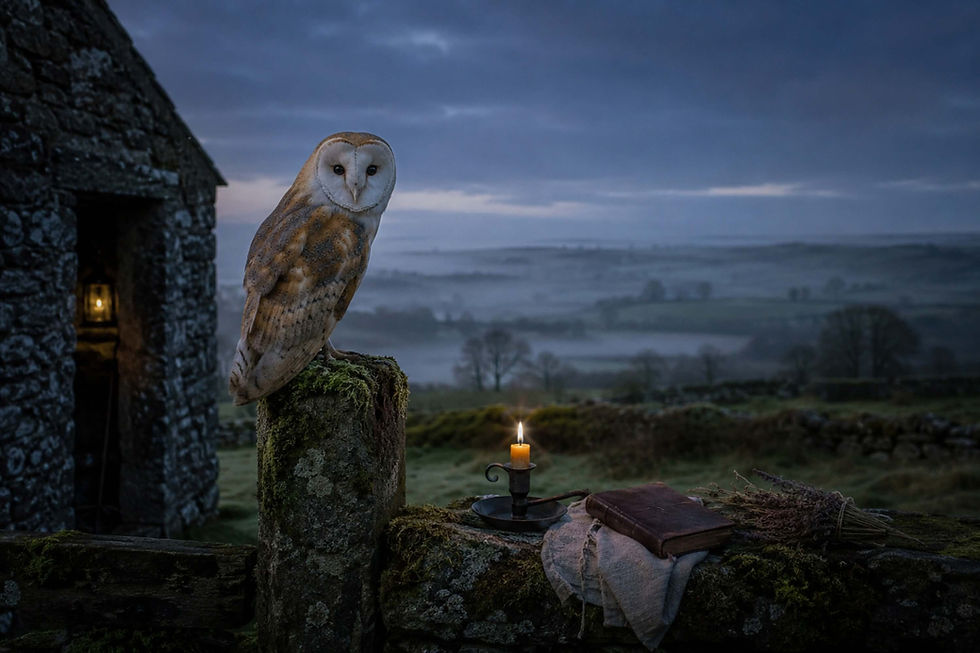
The owl belongs to the hour when the world stops offering itself so plainly. Shapes soften, edges blur, and what seemed easily known in daylight begins to recede into another kind of atmosphere. Yet the owl does not falter there. It does not move like a creature confused by dimness or troubled by what cannot be immediately seen. Its presence suggests something steadier than that. It seems to know that darkness is not always the loss of truth. Sometimes it is simply a different condition in which truth must be approached another way. For the witch, this matters deeply. There are seasons in life when clarity does not come in bright, obvious forms, and the owl reminds us that such seasons are not always failures of perception. They may be invitations to learn another kind of sight.
There is something ancient in the owl’s calm. It does not rush to master the dark. It does not seem to resent uncertainty or demand that the night explain itself more clearly. Instead, it moves within obscurity as though obscurity itself carries information, provided one has the patience to meet it properly. This is part of what makes the owl such a powerful companion in reflective work. It offers an image of perception that does not depend on speed, noise, or immediate answers. The bird does not force light into every shadow. It listens, senses, waits, and then acts with remarkable precision. That way of moving has much to teach the witch, especially in a world that often treats anything unclear as though it must be solved instantly or feared outright.
Within this path, the owl may be approached as a teacher of deeper sight. It reminds the spirit that there are forms of knowing that do not arrive in the first glance. Grief, change, intuition, hidden truth, and inward turning rarely present themselves in the same language as the bright and outward parts of life. They belong more to the dimmer places, where certainty loosens and another kind of understanding begins to gather. Many people resist those conditions because they mistrust what cannot be seen quickly and plainly. The owl offers another response. It shows that a person may remain present without becoming panicked, and that low light does not automatically mean danger. Sometimes it means the soul is being asked to listen more finely, to feel more carefully, and to let slower perception take the lead.
That is why the owl carries such quiet depth. It does not teach the witch to adore darkness for its own sake, nor to mistake confusion for wisdom. Its lesson is subtler and more grounded than that. The owl teaches that not all darkness is confusion, and not all uncertainty is a threat. There are times when the path deepens precisely because a person has learned how to remain steady where the light is low. In those moments, a different truth can begin to show itself — one that the bright hours may have drowned out or rushed past too quickly. The owl stands beside that truth. It says that seeing is not always a matter of more light. Sometimes it is a matter of becoming more still, more patient, and more trustworthy in the way you meet what has not yet fully revealed itself.
How the Owl Teaches Patience Before Clarity
One of the owl’s deepest teachings is that true perception does not always arrive at the speed the mind would prefer. Many people want understanding to come quickly, cleanly, and in a form that leaves no room for uncertainty. Yet much of the deeper life does not unfold that way. It gathers slowly, often beneath the surface, and asks for more patience than certainty. The owl embodies that beautifully. It does not appear to fight the pace of the dark. It does not hurry the moment in order to feel secure. Instead, it waits within the dimness until what needs to be known begins to separate itself from what is merely noise. For the witch, that offers a serious lesson. Clarity may not be absent simply because it has not arrived yet. It may still be gathering, and the soul may need to learn how to remain still enough to receive it.
This matters especially when life enters one of its more shadowed thresholds. A person may be moving through grief, inner change, uncertainty, or a season where familiar answers no longer fit as cleanly as they once did. In such times, the instinct is often to force a conclusion too quickly just to escape the discomfort of not yet knowing. The owl suggests another way. It shows that there can be wisdom in staying present before the full shape of a thing has emerged. That presence is not passive. It is disciplined. It is a form of steadiness that keeps listening even when the world has stopped speaking in obvious language. This is one of the reasons the owl feels so resonant in the deeper life of the Craft. It teaches that waiting is not always delay. Sometimes it is the very condition through which truer sight becomes possible.
A finer kind of listening begins to awaken when the self stops demanding immediate brightness. Sounds grow more distinct. Small shifts matter more. The body senses what the mind might otherwise overlook. In the owl, all of this appears joined together in a way that feels almost effortless, though it is clearly not careless. The bird is not drifting through darkness. It is attending to it with complete precision. That is a powerful image for the witch. There are moments when what is needed most is not another method, not louder certainty, and not more frantic searching, but a better quality of attention. To listen in low light is to trust that subtler forms of truth still exist. It is to recognise that the hidden life of a moment may be more honest than the quick surface reading the mind first reaches for.
What the owl offers, then, is not only sight but timing. It reminds us that understanding often ripens before it becomes visible, and that forcing the answer before it has ripened can distort what we are trying to know. A person who learns from the owl becomes less frightened by pause, less hostile toward uncertainty, and less likely to confuse immediate brightness with the only form of truth. That kind of change can shape the whole path. The witch begins to trust slower perception, quieter knowledge, and the discipline of staying near what has not yet fully shown its face. In that way, the owl teaches patience not as resignation, but as a more faithful way of meeting what is still becoming known.
What Can Be Known When the Light Is Low
Some truths only begin to show themselves once the brighter distractions have thinned. In full light, a person may still be too occupied by surface, by pace, or by the demand to make sense of everything at once. Low light alters that. It asks the eyes to work differently, and it asks the spirit to do the same. The owl belongs to that altered condition. It reminds the witch that there are kinds of knowing which do not announce themselves in obvious form, yet are no less real for that. Intuition often moves this way. So does grief. So does the slower recognition that something in life is changing shape before the mind has found the language to describe it. The owl teaches that such knowledge need not be distrusted simply because it arrives quietly or in fragments. Sometimes fragments are the beginning of truer seeing.
This is where darkness begins to reveal its more difficult grace. Many people fear it because they associate it only with confusion, threat, or the loss of control. Yet darkness can also strip away the false confidence that comes from believing everything important should be immediately visible. It changes the terms of perception. A person has to listen more deeply, notice more subtly, and learn to trust what is sensed before it is fully explained. The owl moves easily within that kind of world. It does not seem diminished by what the ordinary eye would call lack. Instead, it appears sharpened by it. For the witch, that is an important correction. A dim season of life may still be rich with meaning, even when it cannot yet be read in the language of certainty. The path may be less visible there, but it may also be more honest.
There is a kind of maturity in learning not to panic when understanding comes more slowly. The owl carries that maturity beautifully. It does not treat uncertainty as an enemy to be defeated immediately. It remains composed in its presence. That composure is part of its wisdom. A person moving through inward darkness may be tempted to mistake every unclear feeling for danger, or every hidden thing for something that must be brought into harsh light at once. The owl suggests another possibility. Stay near. Listen. Let the outlines soften without assuming you are lost. There are times when the spirit needs exactly that kind of companionship. Not a false promise that everything will become obvious straight away, but a steadier reminder that low light can still hold direction for those willing to move through it with patience and trust.
What can be known in these conditions often carries a different weight from what is learned in easier hours. It has usually been earned through waiting, through inward honesty, and through the refusal to abandon the path simply because it could not be seen clearly all at once. The owl stands beside that kind of knowing. It teaches that perception deepens when the self stops demanding that truth appear only in bright and simple forms. That lesson can change the whole life of the Craft. A witch becomes less dependent on certainty as proof that she is still walking well, and more able to trust the quieter faculties that awaken when the world grows dimmer. In that way, the owl does not only teach how to see in darkness. It teaches how to remain faithful there.
The Gift of Staying Present to What Has Not Fully Revealed Itself
There is a great difference between being lost in darkness and learning how to remain present within it. The owl belongs to the second kind of knowing. It does not suggest confusion for its own sake, nor does it ask the witch to romanticise uncertainty as though every obscured thing were automatically profound. What it offers is steadier than that. It teaches that there are times when the truest response is neither panic nor forced clarity, but faithful attention. A person may not yet know exactly what is unfolding, and still be moving in right relation to it. That is a hard lesson for many to trust. Yet the owl keeps showing that low light does not have to mean helplessness. It may simply mean that the mode of knowing has changed, and that another kind of perception is now being asked to awaken.
This matters deeply in the life of the Craft because so much of inner work unfolds before it can be named cleanly. A change may begin long before the mind has caught up to it. A grief may deepen before its meaning is understood. A truth may circle the edges of awareness for some time before it can finally be spoken aloud. The owl belongs to those hours. It reminds the witch that not everything important becomes visible at once, and that pushing too hard for immediate certainty can sometimes flatten what was still trying to ripen into fuller form. There are moments when the path asks not for brighter methods, but for a calmer spirit. To stay near what is still dim, without rushing to dominate it, is one of the quieter disciplines that deepens real wisdom.
A different kind of courage begins to grow in that atmosphere. It is not the courage of instant action or loud confidence. It is the courage of remaining with what is not yet resolved, and of trusting that truth may still be gathering even while the shape of it remains incomplete. The owl shows that such patience is not weakness. It is a refined kind of steadiness. A person who can listen in low light, and who can let perception sharpen slowly rather than demand premature answers, often comes into a form of knowledge that is more durable than anything seized too quickly. This is part of the owl’s deeper gift. It teaches the witch not only how to notice the hidden, but how to become inwardly still enough that the hidden has room to reveal itself in its proper time.
That is why the owl continues to speak so strongly to the living path. It offers no shallow reassurance, but it offers something better: the reminder that darkness does not always mean the absence of guidance. Sometimes it means guidance is arriving in a quieter register. What is seen there may carry more depth precisely because it was not won through haste. A witch who learns from the owl becomes less afraid of the hours when the way forward is not obvious, and more able to trust the slower forms of clarity that emerge through patience, listening, and right presence. In that sense, the owl teaches more than sight. It teaches how to remain true to the path when certainty is low and perception itself must become the light.
Blessing of the Owl’s Sight
"I trust the dark, I do not flee,
What hides in shadow speaks to me.
With patient heart and inward sight,
I learn to see where there is night."
Closing Wisdom
The owl carries a wisdom that many people need but do not always welcome at first. It does not promise that every important truth will arrive in bright, obvious form. Instead, it reminds the witch that some forms of knowing belong to dimmer hours, when the outlines of things are softer and the spirit must rely on patience more than certainty. That is part of what gives the owl such depth. It teaches that darkness is not always a condition to escape as quickly as possible. At times, it is the place where a different quality of perception begins to awaken, one that is quieter, steadier, and less dependent on immediate answers. What is seen there may be slower to arrive, yet it often carries a different kind of truth from what can be grasped at a glance.
There is real strength in learning not to fear that kind of seeing. A person does not become less faithful to the path because they are moving through uncertainty, grief, change, or inward night. Often the path is deepening there in ways that brighter hours could not have taught. The owl shows that the witch may remain present to what has not yet fully revealed itself without becoming lost in it. She may listen more finely, trust more patiently, and learn to recognise that not all darkness is confusion. Some of it is simply the condition in which hidden things become knowable. In that way, the owl becomes more than a creature of the night. It becomes a teacher of steadiness, of slower perception, and of the grace of remaining with what is still gathering into truth.
In The Ancient Irish Craft, we remember:
What is seen in darkness often carries a different kind of truth.
The Trove Remain Open
If you wish to continue your Craft in your own time, the Craft Guides and Craft Teachings offer clear PDF paths for practical work, deeper study, ritual understanding, and steady return.
The Craft Guides
A practical collection of focused PDF Craft Guides for hearth, home, protection, seasonal awareness, folk magic, and everyday ritual — created to support steady Craft practice in your own time.
Craft Teachings
A deeper collection of printable Craft Teachings — focused studies, ritual understanding, folk magic, reflection, and grounded instruction gathered into clear PDF paths for those ready to go further within the Craft.
Wherever you stand within the Craft, the path continues inward.
Many blessings to you and yours,
Sorcha Lunaris
Keeper of The Ancient Craft.
Want to read more?
Subscribe to theancientirishcraft.com to keep reading this exclusive post.


