


The Ewe at First Milk — Irish Imbolc Renewal
- Sorcha Lunaris

- Jan 29
- 8 min read
Updated: Apr 7
“What is nourished first will rise in its proper time.”
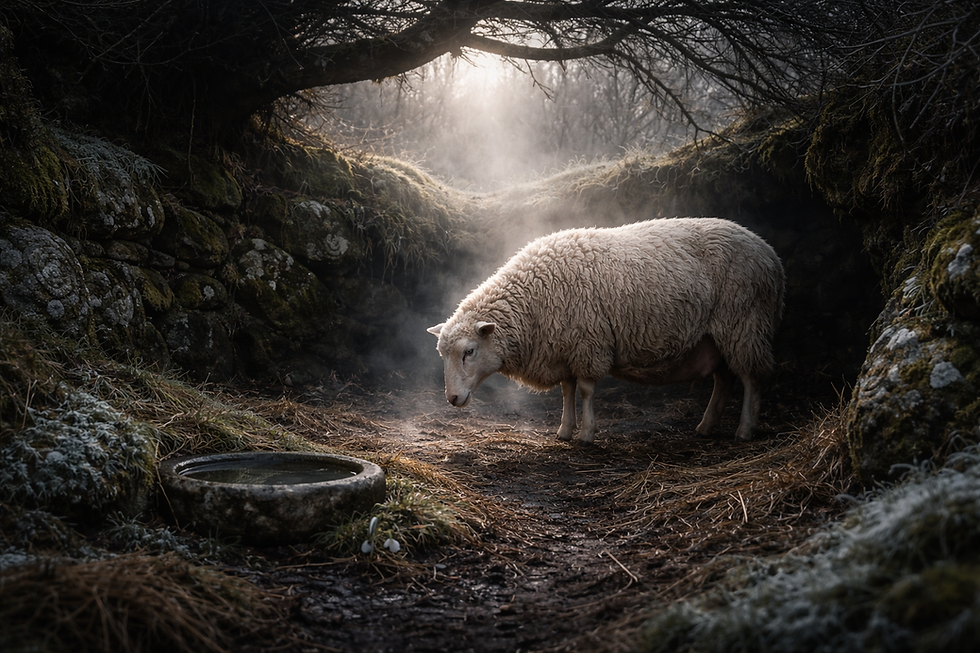
In Irish seasonal awareness, Imbolc is marked less by what can be seen than by what has begun to move within living bodies. The ewe’s first milk is one of the earliest signs that winter’s hold is loosening in a meaningful way. Fields may remain bare and skies still heavy with rain, yet the return of milk shows that life is preparing itself quietly for continuation. This shift is understood as internal rather than outward, rooted in nourishment rather than growth. The ewe therefore becomes a living signal that the cycle has turned toward sustenance long before it turns toward abundance.
Unlike later seasonal markers associated with blossom or warmth, the ewe’s milk belongs to a hidden stage of renewal. It appears before lambs are visible and before grass thickens in the fields. This makes it a powerful sign in Irish land-based awareness, because it reveals change that cannot yet be confirmed by the eye. What matters is not display but capacity — the land’s ability to feed what will soon depend upon it. The ewe embodies this principle directly: her body shows that the season has shifted toward provision even while winter still shapes the surface of the world.
For those observing the year through animal life within a contemporary Irish witchcraft path, the ewe at Imbolc represents continuity rather than awakening. She does not symbolise emergence or motion, but the return of a sustaining current that has been absent through the depths of winter. This distinguishes her from creatures associated more strongly with light or fire. Her meaning lies in what she carries rather than how she moves. Milk is not seen as a sign of arrival but as proof that the work of renewal has already begun in secret. The ewe therefore stands for the stage of the year when survival gives way to the first quiet form of care.
Within this context, the ewe’s role at Imbolc is not dramatic but essential. She marks the point where the cycle turns toward the future by preparing to support it. Her presence does not announce spring, nor does it banish winter. Instead, it demonstrates that endurance has shifted into nourishment. This is a different kind of threshold from those marked by light or heat. It is a threshold of responsibility: the moment when what will come next must be fed rather than merely waited for. The ewe’s first milk thus becomes a seasonal language of readiness expressed through the body.
Nourishment Before Growth
Within a contemporary Irish witchcraft sensibility, the ewe at first milk teaches that renewal begins with the capacity to sustain rather than the impulse to expand. Her significance does not lie in movement or display, but in readiness to give what is needed for life to continue. This reframes Imbolc not as a moment of emergence, but as a moment of responsibility. The return of milk shows that the cycle has shifted from mere survival toward support. For the witch, this carries an ethical lesson: before seeking visible change, one must ensure that what is beginning has a source of nourishment strong enough to hold it.
The ewe’s presence also reshapes how growth is understood. Rather than symbolising speed or vitality, she embodies steadiness and provision. Milk arrives slowly, in rhythm with the body, and only when conditions are right. This teaches that beginnings are not driven by desire alone but by preparedness. In Irish Craft thinking, this principle applies not only to animals or land, but to paths, intentions, and inner developments. What arises at Imbolc should not yet be pushed outward. It must first be tended inwardly, protected from strain, and given time to strengthen before it is asked to move.
Unlike creatures associated with light or fire, the ewe does not point toward action but toward care. Her lesson is that life does not return all at once, and that the earliest work of the year is often invisible labour. To nourish is to commit to what has not yet proven itself. The ewe’s milk appears before there is proof that lambs will thrive or that spring will arrive gently. In this way, she represents faith grounded in bodily reality rather than hope alone. The witch learns from her that sustaining what is small and fragile is itself a form of alignment with the turning year.
As a seasonal emblem for Imbolc, the ewe therefore stands for beginnings that must be held rather than displayed. Her symbolism resists the urge to announce progress or claim transformation prematurely. Instead, she teaches that renewal must first be capable of supporting what it calls forth. This places care at the centre of seasonal wisdom. Growth without nourishment leads to collapse; movement without provision leads to exhaustion. Through the ewe, contemporary Irish witchcraft frames Imbolc not as the start of motion, but as the return of the means by which motion can one day be sustained.
Milk as the First Language of Spring
Want to read more?
Subscribe to theancientirishcraft.com to keep reading this exclusive post.


