Imbolc, the First Breath of the Year — Irish Sacred Time and Origins
- Sorcha Lunaris

- Jan 30
- 7 min read
“The year begins to exhale.”

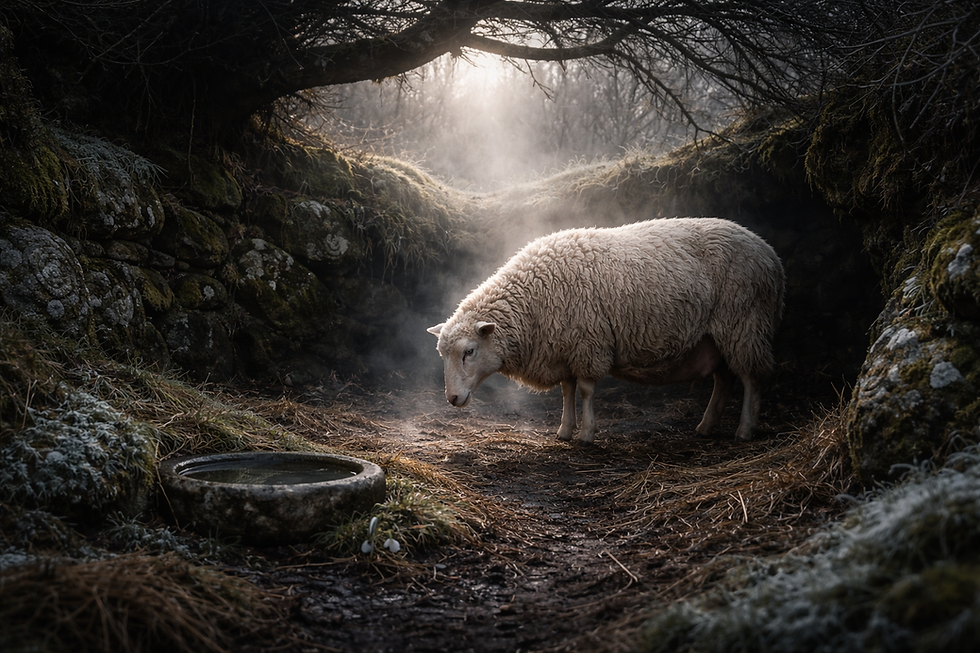
Imbolc is among the most ancient markers in the Irish seasonal cycle, arising not from ceremony but from the realities of survival and animal life. Its name is commonly linked to i mbolg, meaning “in the belly,” referring to pregnancy in ewes rather than to human ritual. This places Imbolc firmly in the world of herding and subsistence, where the future of a household depended upon whether animals could safely carry and later nourish their young. Long before Imbolc became a festival or sacred observance, it existed as a moment of recognition: a point when life had begun to prepare itself for continuation despite winter’s ongoing hardship.
In early Irish communities, this moment mattered because it represented the first internal movement of the year away from pure endurance. Fields remained bare, and cold still ruled the land, but something essential had changed beneath the surface. Animals had entered a phase of readiness, and with that came the promise of milk and sustenance in the weeks ahead. Imbolc therefore did not mark growth but potential. It was a sign that the future could once again be anticipated rather than feared. This distinction shaped how the time was understood: not as relief from winter, but as the earliest proof that winter would not be endless.
Unlike later seasonal markers tied to planting or harvest, Imbolc was rooted in the inner workings of living bodies rather than in visible change. It did not depend on blossoms or warmth, but on the hidden processes of gestation and nourishment. This made it a deeply embodied moment in the year, grounded in what could be felt rather than what could be seen. For witches looking back toward these origins, Imbolc reveals itself as a time defined by internal turning rather than outward expression. The year had not yet opened, but it had begun to breathe again.
From its earliest appearance, Imbolc carried the meaning of threshold without spectacle. It did not arrive with dramatic signs, nor did it signal immediate safety or abundance. Instead, it marked the moment when the cycle of life had shifted from holding to preparing. This is why Imbolc endured in memory even before it was named. It was not a date chosen for symbolism; it was a change discovered through attention. The first breath of the year was recognised because people needed to know when life could begin to be trusted again.
Historical Development of Imbolc
As Irish society evolved, the significance of Imbolc gradually moved from unspoken observation into cultural memory. What had once been recognised only through the behaviour of animals became something that could be anticipated and named. This shift did not occur through the sudden invention of ceremony, but through repetition. Year after year, the same internal signs appeared at the same point in the dark season, teaching people when the year began to loosen its grip. Over generations, this consistency gave Imbolc a fixed place within the seasonal structure long before formal calendars or written tradition emerged.
Because Imbolc was rooted in herding rather than agriculture, its customs remained domestic and restrained. There was little reason for large gatherings or communal feasts, as food was still limited and work remained cautious. Instead, attention stayed close to the home: to animals, to stored goods, and to the maintenance of what had survived winter so far. This gave Imbolc a character unlike that of later festivals. It was not outward-facing or celebratory, but watchful. Its role was to confirm that planning for the future had become possible again.
Want to read more?
Subscribe to theancientirishcraft.com to keep reading this exclusive post.