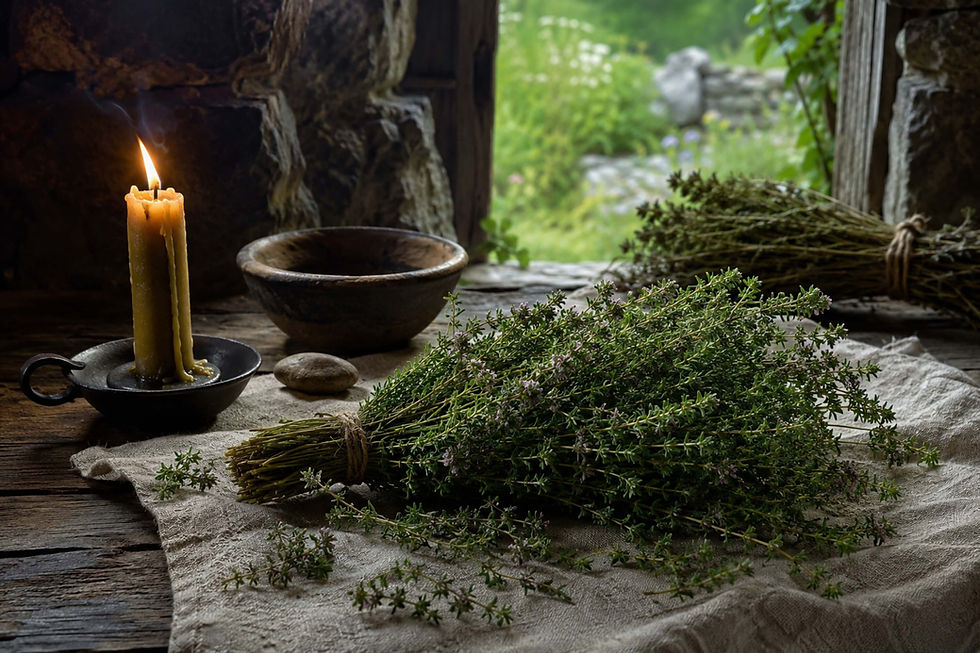
Rosemary and the Keeping of What Matters — Herbal Wisdom
- Sorcha Lunaris

- Apr 23
- 12 min read
“What is faithfully kept does not easily fade.”

Some plants seem to announce their character gently over time, while others carry it so clearly that even their presence feels like a kind of statement. Rosemary belongs to the latter. It has long been held close in herbal tradition as a plant of remembrance, clearing, and protection, and it is difficult to think of it as vague in spirit. There is something bright, wakeful, and steady about it. It does not suggest softness in only one form, nor does it feel like a herb of passive comfort. Its nature seems more exacting than that. Rosemary carries the impression of freshness that restores order, of sharpness that clears heaviness, and of care that does not indulge what has begun to grow dull. That is part of why it has remained so enduring in herbal memory. It feels like a plant that keeps things from slipping too far into neglect.
In older herbal understanding, a plant was rarely respected only for beauty or scent. It was known by use, by repeated handling, and by the role it played in helping life remain steadier, cleaner, or better held together. Rosemary carries that kind of reputation strongly. Its long association with remembrance gives it more than sentimental value. Memory, in older wisdom, is not simply the storing of the past. It is also the keeping of what should not be lost. A plant tied to remembrance therefore stands close to loyalty, continuity, and the refusal to let what matters become clouded or forgotten. This gives rosemary a very particular authority. It speaks not only to recollection, but to the disciplined work of keeping something alive in the mind and spirit. There is a kind of practical devotion in that, and the herb seems to embody it without needing to exaggerate its presence.
Its long-standing place in clearing and protection deepens that character further. Rosemary does not feel like a herb that merely soothes whatever surrounds it. It feels as though it brightens, sharpens, and refreshes the atmosphere so that what is true may stand more cleanly. In broader folk practice, that makes it especially compelling, because not all protection works through heaviness, sealing, or force. Some forms of protection work by keeping a place from becoming stale, muddied, or spiritually neglected in the first place. Some forms of protection come through freshness, through honest air, through a refusal to let the mind or the room grow dim. Rosemary belongs very naturally to that kind of wisdom. It reminds the witch that care is not always soft in the same way. Sometimes care has a brisker quality. It clears, steadies, and restores without needing to become harsh.
That is part of why rosemary still speaks so clearly in reflective herbal work now. It offers a lesson that is simple in form but far-reaching in consequence. Not everything in life is strengthened by comfort alone. Some things are strengthened by clarity. Some by wakefulness. Some by the quiet and repeated act of keeping what matters from slipping out of sight. Rosemary seems to stand beside that kind of discipline. It suggests that a life may become burdened not only by pain or difficulty, but by dimness, by neglect, and by the slow fading of what should have been tended more faithfully. In that sense, the herb offers more than a pleasant or familiar association. It becomes a reminder that memory, devotion, and inward order all require keeping. What is left unattended too long may weaken, while what is faithfully kept has a better chance of remaining bright, true, and alive.
What Rosemary Refuses to Let Grow Dim
One of the reasons rosemary carries such lasting force in herbal wisdom is that its nature feels direct rather than hidden. Some herbs invite long interpretation before their deeper qualities begin to show themselves. Rosemary seems to arrive already speaking in a clearer voice. It brings with it the sense of brightness, freshness, and wakefulness, and these are not qualities without consequence. They suggest a way of meeting life that resists dullness before dullness settles too deeply. In a spiritual sense, this matters greatly. A person does not always lose their way through open harm or obvious collapse. Quite often, what matters begins to fade through neglect, through clouded attention, or through the gradual thinning of inward care. Rosemary stands against that sort of fading. It carries the impression of a plant that asks things to be kept clean, remembered, and properly held before they are lost to quiet diminishment.
That gives rosemary a particular depth when it is approached as more than a useful herb or a familiar household plant. Its old associations with remembrance and protection begin to join one another in a meaningful way. To remember well is already a form of protection. It keeps what is valuable from slipping too easily beyond reach. It preserves the inward thread that joins a person to what they know, what they honour, and what they must not allow to become indistinct. Older herbal wisdom often works through exactly this kind of practical symbolism. A plant’s nature is not separated neatly into categories, but is understood as carrying a whole character. Rosemary’s character suggests keeping. It keeps the atmosphere fresher, the intention clearer, the mind more alert, and the heart closer to what deserves not to be forgotten. That is not a small quality. It is a form of steadiness with real spiritual consequence.
There is something especially valuable in this because dimness can be difficult to recognise while it is happening. A room may not feel overtly wrong and still seem less alive than it should. A person may not feel openly lost and still have drifted from what once kept them inwardly ordered. This is where rosemary’s wisdom becomes so useful. It reminds the witch that what clouds a life is not always dramatic. Sometimes it is simply the slow gathering of spiritual dust, the neglect of small acts of devotion, the allowing of attention to become too scattered, or the quiet abandonment of what once kept the spirit clear. Rosemary seems to answer those conditions not with force, but with freshness. It says that some things must be brightened before they can be protected well. Some things must be remembered before they can be restored. Some things must be kept before they can keep you in return.
This is why the herb carries a wisdom that feels both modest and strong. It does not shout its lesson, yet the lesson remains exacting. Keep the mind from dullness. Keep the atmosphere from stagnation. Keep the inward life from drifting too far from its own centre. Keep memory alive. Keep devotion awake. Keep the small but essential thread of self-respect intact even when life grows crowded or untidy. Rosemary feels close to all of that. It does not flatter forgetfulness, and it does not seem interested in comforting a person into passivity. Instead, it offers a clearer kind of care. It brightens what has grown dim and asks that what matters be treated as though it truly matters. In that way, rosemary becomes more than an herb linked with remembrance. It becomes a teacher of faithful keeping, and of the quiet strength required to keep certain things bright enough not to fade.
Keeping the Inner Life Bright
A life does not always lose its shape through great sorrow or obvious upheaval. Just as often, it becomes dimmer by slower means. Attention is thinned by too many competing demands. Devotion is postponed until it grows faint through lack of use. The home is still functioning, the person is still moving, yet something inward has lost its brightness. This is one of the reasons rosemary feels so spiritually exact. It speaks to the kinds of weakening that do not always announce themselves as crisis. A person may still be carrying on and yet no longer feel fully gathered, fully clear, or fully near to what matters most. In that sense, rosemary offers more than comfort. It offers correction. It reminds the witch that inward order does not always disappear dramatically. Sometimes it fades quietly, and what fades quietly must be tended deliberately if it is to return in a living way.
There is great wisdom in recognising that not everything is healed by softness in the same form. Some conditions do not need further easing. They need brightening. They need fresh air, cleaner intention, and a more wakeful kind of care. Rosemary belongs to that sharper mercy. It does not feel severe, yet neither does it seem willing to let the spirit settle into stagnation without challenge. Its old associations with clearing and remembrance suggest exactly this kind of work. What has grown clouded may need to be clarified. What has been neglected may need to be consciously brought back into care. What has been allowed to drift may need to be recalled. In lived practice, that can apply to the atmosphere of the home, the state of the mind, the quality of one’s words, or the subtle discipline of remembering what one has no wish to lose inwardly.
This makes rosemary especially meaningful in the quieter rhythm of everyday keeping. Not every herb teaches through spectacle, and rosemary does not need to. Its wisdom belongs to the repeated act of choosing not to let what matters fall into carelessness. A room may be freshened before heaviness settles too deeply. A small household blessing may be spoken before the atmosphere grows stale. A person may pause long enough to remember what they are trying to protect in themselves before the day scatters them too far from it. These are not dramatic acts, yet they carry the same underlying intelligence. They keep life from growing spiritually untidy. They resist the slow erosion that can come when nothing is tended until it has already dimmed too far. Rosemary seems to stand beside those choices, asking not for grand display, but for faithfulness, freshness, and a cleaner holding of what is good.
There is something quietly beautiful in that kind of teaching because it joins memory with self-respect in a very practical way. To keep what matters bright is not only to honour the thing itself. It is also to refuse the kind of inward neglect that leaves a person less steady, less clear, and less able to recognise their own centre. Rosemary points toward a life in which certain things are not allowed to fade simply because life has become crowded. Clarity is kept. Devotion is kept. The atmosphere of the home is kept. The mind is kept from unnecessary dullness. The heart is kept close to what it must not betray. This is not rigid living. It is faithful living. It asks the witch to remain in relationship with what they know in their bones, and to care for that knowing before it becomes obscured by noise, fatigue, or forgetting.
The Quiet Strength of Faithful Keeping
There is a kind of strength that does not reveal itself through force, but through what it refuses to let fall away. Rosemary speaks very clearly to that form of steadiness. It does not suggest the restless urge to add more, gather more, or intensify everything at once. Its wisdom feels more exacting than that. It asks what in a life must be kept bright if the spirit is to remain clear. It asks what must be protected not through panic, but through faithful attention. Memory is part of this. Devotion is part of this. So too is the atmosphere of the home, the tone of the mind, and the inward thread of self-respect that helps a person remain ordered when life grows crowded. Rosemary seems to stand beside those things and remind us that what matters most is not always what shouts for notice, but what quietly depends on being remembered well.
This is one of the reasons the herb feels so enduring in reflective work. It teaches that neglect is not always dramatic, and that forgetting often begins in small ways. A person may still value what is true and yet fail to tend it consistently enough for it to remain vivid. The result is not always immediate collapse. More often, it is a gradual dimming. What once felt central begins to lose its brightness through inattention. Rosemary offers a steadier answer than fear. It does not urge frantic correction. It suggests clear keeping. Open the room. Freshen the air. Restore the intention. Remember what deserves not to be lost. There is practical wisdom in this. Some things do not need reinvention. They need tending. Some truths do not need to be dramatically rediscovered. They need to be kept close enough that they do not fade beneath the pressure of ordinary life.
For the witch, this kind of keeping becomes an important form of discipline. It asks whether the inward life is being maintained with enough honesty to remain recognisable. It asks whether what is spoken, blessed, remembered, and protected is still being approached with real care, or whether familiarity has allowed it to slip into carelessness. Rosemary’s lesson is especially valuable here because it resists both heaviness and passivity. It carries a cleaner energy than that. It brightens rather than flatters. It steadies rather than indulges. In this way, it teaches a more mature form of care, one that does not wait until everything has become clouded before it responds. The herb seems to prefer prevention to rescue, and wakefulness to recovery after needless neglect. That is part of its gift. It reminds the spirit that clear keeping is often wiser than late repair.
What rosemary preserves, then, is not only memory in the narrow sense, but a whole manner of remaining true. It calls the person back toward what they know, what they honour, and what they cannot afford to let grow dim if they wish to remain inwardly gathered. This is why its wisdom feels so quiet and so strong at once. It asks for no performance, yet it demands sincerity. It does not seek to overwhelm, yet it will not bless a life of inattention without challenge. In the end, rosemary teaches that faithful keeping is one of the deepest forms of strength. Not everything valuable is protected by walls, force, or dramatic acts. Some of it is protected by freshness, by repetition, by clear intention, and by the refusal to let what is good be slowly forgotten. What is faithfully kept does not easily fade, because it has been met again and again with living care.
A Rosemary Act of Keeping
Choose one small part of your life that has begun to feel slightly dim, neglected, or less held than it should. Do not choose too much at once. Let it be something clear enough to meet honestly: the atmosphere of a room, the tone of your morning, a simple devotional corner, the freshness of the home, or some inward quality such as clarity, steadiness, or remembrance. The purpose is not to create a grand symbolic exercise, but to notice where a little faithful keeping is now needed. Rosemary works best in this mood when it is approached as a companion to clear attention rather than as a dramatic cure for everything at once.
Bring a little rosemary into that chosen moment in a way that feels practical and real. This may mean placing a small sprig near the place you want to tend, holding it briefly while you open a window and freshen the air, or keeping it near you while you speak a plain intention over what is being restored to care. Let the act remain simple. What matters is the quality of the attention, not the complexity of the method. As you do it, name quietly what you do not want to let fade. It may be peace, devotion, memory, clarity, self-respect, or some other small bright thing that deserves not to be lost through neglect.
Afterwards, resist the urge to turn the moment into something larger than it needs to be. Let the act stay modest and let its meaning settle naturally. Rosemary’s deeper teaching belongs to repeated faithfulness more than to spectacle. Return to the same place, quality, or intention again in the days ahead if needed, not because it has failed, but because keeping is often done through continuation rather than through one decisive gesture. What is brightened once may need brightening again. What matters is that you have chosen not to let it slip further into dimness unnoticed. That choice, made calmly and clearly, is already part of the wisdom the herb carries.
Blessing of Faithful Keeping
"I keep what’s true, I keep it bright,
I guard its flame with steady sight.
No dimming drift shall carry me,
What I hold close stays clear and free."
Closing Wisdom
Rosemary offers a form of wisdom that is easy to underestimate because it arrives without spectacle. It does not demand attention through drama, yet it continues to endure because its teaching is so exact. It reminds us that a life may weaken not only through pain or conflict, but through the slow fading of what should have been kept bright. Clarity can grow dull. Devotion can thin. The atmosphere of a home can lose freshness. Memory can become less living. What matters may still be valued, yet not tended closely enough to remain strong in practice. Rosemary stands against that sort of dimming. It teaches that some of the deepest care is not about adding more, but about keeping well what already deserves to be held.
There is real strength in that kind of faithfulness. It asks for no performance, only sincerity. It asks whether the mind is being kept clear, whether the home is being kept fresh in spirit, and whether the heart is staying near what it knows it must not lose. These are quiet questions, yet they shape a life more deeply than many louder ones. Rosemary reminds the witch that self-respect, remembrance, and inward order are not maintained by accident. They are kept alive through repeated, living attention. What is faithfully tended remains more able to steady the spirit in return. In that way, the herb offers something more than a pleasant old association. It offers a discipline of keeping, and a bright, enduring reminder that what is truly cared for does not easily fade into neglect.
In The Ancient Irish Craft, we remember:
What is faithfully kept does not easily fade.
Go Deeper Through the Trove
If you feel called to continue your practice in your own time, the Craft Guides and Craft Teachings offer focused PDF paths for study, ritual, and steady everyday Craft work.
The Craft Guides
A practical collection of focused PDF Craft Guides for hearth, home, protection, seasonal practice, folk magic, and everyday ritual — created to bring clear, steady guidance into your own Craft practice.
Craft Teachings
A deeper collection of printable Craft Teachings for focused study, ritual understanding, folk magic, reflection, and grounded Craft practice — created to offer richer guidance for those ready to go further.
The path deepens in its own time.
Many blessings to you and yours,
Sorcha Lunaris
Keeper of The Ancient Craft.
Want to read more?
Subscribe to theancientirishcraft.com to keep reading this exclusive post.