The Teaching of Nettle: Irish Herbal Wisdom and Witchcraft Resilience
- Sorcha Lunaris

- Feb 26
- 7 min read
“What protects itself often has the most to give.”
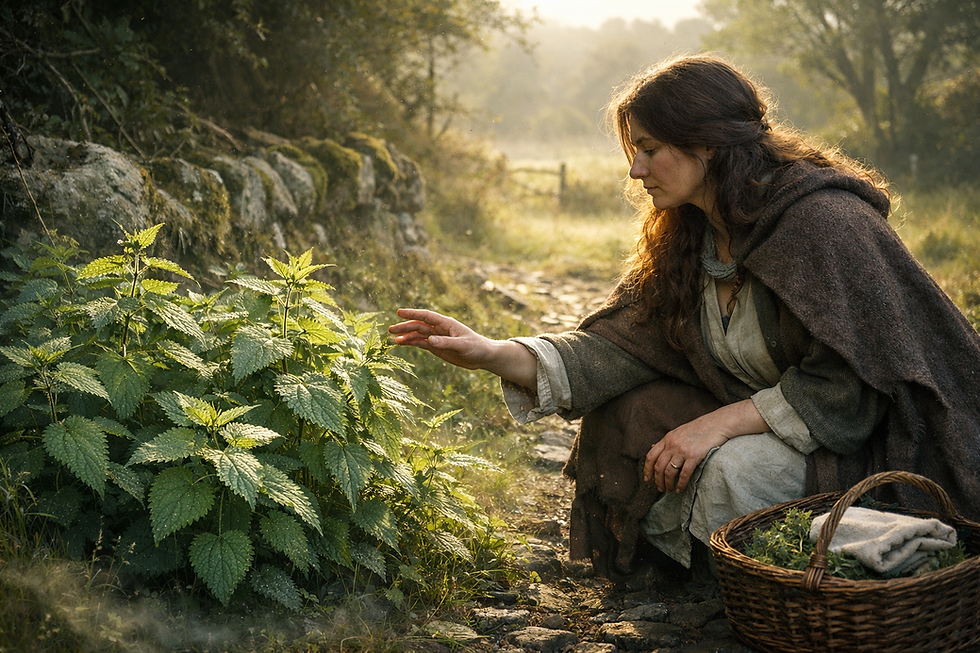
In Irish folk herbal practice, nettle was recognised as one of the earliest returning plants of the year, appearing as the land began to shift out of winter’s hold. Although its sting made it easy to overlook or avoid, traditional communities understood it as a valuable sign of renewal rather than a nuisance. Growing strongly along paths, field edges, and disturbed soil, nettle indicated fertile ground and a landscape beginning to recover its vitality. For practitioners of the old ways, such growth signalled that the season itself was offering support — not softly, but with the kind of strength that demanded attention and respect.
Within Irish household and folk practices, nettle was gathered carefully for nourishing spring tonics, strengthening broths, and remedies intended to restore the body after the depletion of winter. It was valued for helping clear heaviness, support circulation, and renew energy at a time when people and land alike were beginning to move again. These uses were practical rather than mystical, yet they carried quiet ritual importance. Gathering the first nettles often marked a subtle seasonal turning — an acknowledgement that the body must be prepared for the work and growth that spring would soon require.
Irish witchcraft sensibility absorbed these herbal traditions into a broader understanding of energetic timing. Nettle was not treated as a decorative magical herb but as a plant aligned with resilience, protection, and renewal through challenge. The sting itself became part of the teaching: strength that nourishes does not always arrive gently. For some practitioners, nettle branches were hung near thresholds or worked into protective seasonal customs, not as aggressive wards but as reminders that living boundaries protect what they sustain.
Seen through this lens, nettle represents an early-season conversation between the practitioner and the land. It offers nourishment while demanding mindful approach, encouraging the witch to meet renewal with awareness rather than haste. The plant’s presence asks a simple question — can you accept strength that comes with responsibility? In this way, nettle becomes more than a medicinal herb; it becomes a teacher of respectful relationship, reminding the practitioner that what restores vitality often requires patience, care, and willingness to engage with life exactly as it appears.
How Nettle Was Worked Within Irish Craft
Within Irish folk practice, nettle occupied an unusual place because it crossed the boundary between nourishment, protection, and practical magic. While many herbs were gathered primarily for flavour or healing, nettle carried an additional reputation for strengthening the household itself. Fresh growth was sometimes brought near doorways or boundaries during seasonal transitions, reflecting the belief that vitality should be invited into the home while harmful influence remained outside. These customs were rarely dramatic rituals; they were quiet acts woven into everyday life, reinforcing the idea that protection worked best when it felt natural rather than forced.
Nettle was also associated with the rebuilding of personal strength after difficult periods. In Irish witchcraft sensibility, plants that supported recovery after winter were understood as allies in restoring balance between body and spirit. Drinking strengthening herbal preparations or handling freshly gathered nettle marked a symbolic return to participation in the year’s movement. The act itself acknowledged that resilience required nourishment, not just endurance. Through this relationship, the practitioner recognised that the body was not separate from magical practice but one of the foundations through which intention could be sustained.
In protective workings, nettle’s natural sting provided an obvious metaphor, yet traditional use favoured subtlety over aggression. Rather than using the plant as a weapon against others, Irish Craft logic framed it as a teacher of boundaries — a reminder that protection begins with clarity and self-respect. A plant that defends itself without chasing or pursuing harm reflected the ideal of steady defence rather than reactive conflict. This approach aligned with broader folk practices where quiet safeguarding was preferred over displays of force.
Through repeated seasonal use, nettle became a practical symbol of survival transformed into strength. Its ability to thrive in difficult ground mirrored the practitioner’s own capacity to recover and continue after hardship. Irish witchcraft drew meaning from this observation, teaching that renewal does not erase struggle but grows through it. In this way, nettle’s role in the Craft extended beyond herbal utility; it embodied the understanding that strength, nourishment, and protection can arise from the same source when approached with awareness and respect.
The Witch’s Lesson in Vital Strength
Within Irish witchcraft understanding, nettle is often read as a lesson in how strength expresses itself honestly. Unlike plants that appear soft or inviting, nettle declares its nature immediately, asking the practitioner to approach with awareness rather than assumption. This directness reflects a key Craft principle: vitality that protects itself is not hostile — it is clear. For the witch, the plant becomes a mirror, revealing that resilience does not require hardness alone but the ability to maintain boundaries while still offering nourishment. The teaching begins with recognising that strength and generosity are not opposites but partners.
Nettle also illustrates the idea that renewal rarely arrives in forms that feel effortless. Irish seasonal wisdom teaches that early growth emerges through cold ground and unstable weather, requiring endurance before comfort. The sting symbolically echoes this reality, reminding the practitioner that transformation often carries a moment of discomfort before its benefits become apparent. Through observing and working with nettle, the witch learns to recognise that challenge is not always a warning to withdraw; sometimes it signals that something potent is present and asking to be engaged with carefully.
This teaching extends into how the practitioner understands personal protection. The Craft emphasises that clear boundaries are not built from fear but from vitality grounded in self-awareness. Nettle defends itself only when touched, demonstrating a kind of quiet integrity that neither seeks conflict nor avoids it unnecessarily. For the witch, this becomes an important lesson about energy itself — protection works best when it is rooted in stability and self-respect rather than reaction or aggression. Strength held calmly often proves more effective than force used impulsively.
Through this lens, nettle becomes more than an herb used at a certain time of year; it becomes a model for how resilience can mature within practice. The plant teaches that what appears harsh at first encounter may hold deep nourishment once relationship is established. Irish witchcraft encourages the practitioner to carry this awareness into her own life — to approach challenges with attentiveness, to honour boundaries without closing the heart, and to recognise that true vitality often reveals itself through clear, grounded presence rather than softness alone.
Renewal That Defends What It Sustains
As the season turns and vitality begins returning to the land, nettle offers a reminder that renewal is rarely passive. In Irish Craft understanding, early growth carries its own form of protection, ensuring that what emerges can survive the unpredictable conditions of spring. The plant’s presence at paths and boundaries reflects this lesson clearly — life returning with strength, yet aware of its limits. For the practitioner, this becomes an invitation to consider how new energy is being protected within her own life, recognising that growth without boundaries often struggles to endure.
Irish folk practitioners observed that plants thriving in difficult environments often carried teachings about endurance. Nettle’s ability to flourish in disturbed ground suggested that vitality does not wait for perfect circumstances but adapts and persists where it can. This observation shaped how the plant was understood symbolically within witchcraft practice: resilience does not mean resisting change endlessly, but learning how to root oneself firmly enough that change becomes navigable. The witch learns that steadiness arises not from avoiding challenge but from meeting it with awareness and grounded presence.
The teaching of nettle also deepens the practitioner’s understanding of reciprocity with the land. Gathering or working with the plant required knowledge, care, and timing, reinforcing the idea that benefit comes through relationship rather than taking without thought. Irish witchcraft places strong emphasis on this mutual exchange — the land offers support, but the practitioner must approach respectfully and with understanding. Nettle’s sting acts as a natural reminder of this balance, ensuring that interaction remains conscious rather than careless.
Through this perspective, nettle becomes a quiet guide into the heart of herbal wisdom within the Craft. It shows that strength can nourish, that boundaries can protect without closing off life, and that renewal often asks for participation rather than ease. The practitioner who learns from nettle begins to recognise that resilience is not simply the ability to survive, but the ability to continue offering vitality while remaining rooted in clear self-awareness. In this way, the plant teaches that what protects itself well often becomes the strongest source of nourishment for others.
Blessing of the Living Nettle
"By guarded leaf and rooted will,
Let strength rise quiet, deep, and still.
What stings may wake, what heals may stay,
And guide my spirit’s steadier way."
Closing Wisdom
The Teaching of Nettle reminds the practitioner that strength within Irish witchcraft is rarely separated from responsibility. A plant that nourishes deeply while protecting itself so clearly reflects the way the Craft understands resilience — not as hardness, but as vitality that knows its boundaries. Through seasonal gathering and careful use, nettle became more than a remedy; it became a quiet reminder that renewal often asks for respect before it offers support. Its presence at the edges of paths mirrors the practitioner’s own journey, where growth and protection must move together if what emerges is to endure.
Through this reflection, the witch learns that resilience is active, rooted, and responsive rather than defensive alone. Nettle teaches that life strengthens itself without withdrawing from the world, offering nourishment while remaining clear about its limits. Irish witchcraft carries this lesson into practice, encouraging a relationship with both plants and personal energy that honours reciprocity and awareness. In this way, the teaching becomes deeply practical: what protects itself wisely often becomes the most sustaining presence. The Craft therefore reminds us that true vitality is not softness without boundary, but life that knows how to remain open while standing firmly in its own strength.
In The Ancient Irish Craft, we remember:
What protects itself often has the most to give.
Carry the Work More Fully
As your relationship with the Craft deepens, you may feel drawn toward greater continuity and deeper work.
The Craft Guides
A practical path of steady Craft work through focused PDF guides, where hearth, home, protection, seasonal practice, folk magic, and daily ritual are made clear, grounded, and easy to return to.
Craft Teachings
A deeper path of study and practice through printable Craft Teachings, where focused subjects are explored with fuller context, ritual understanding, reflection, and grounded ways to carry the Craft into lived practice.
Where readiness meets the path, the next step becomes clear.
Many blessings to you and yours,
Sorcha Lunaris
Keeper of The Ancient Craft.
Want to read more?
Subscribe to theancientirishcraft.com to keep reading this exclusive post.