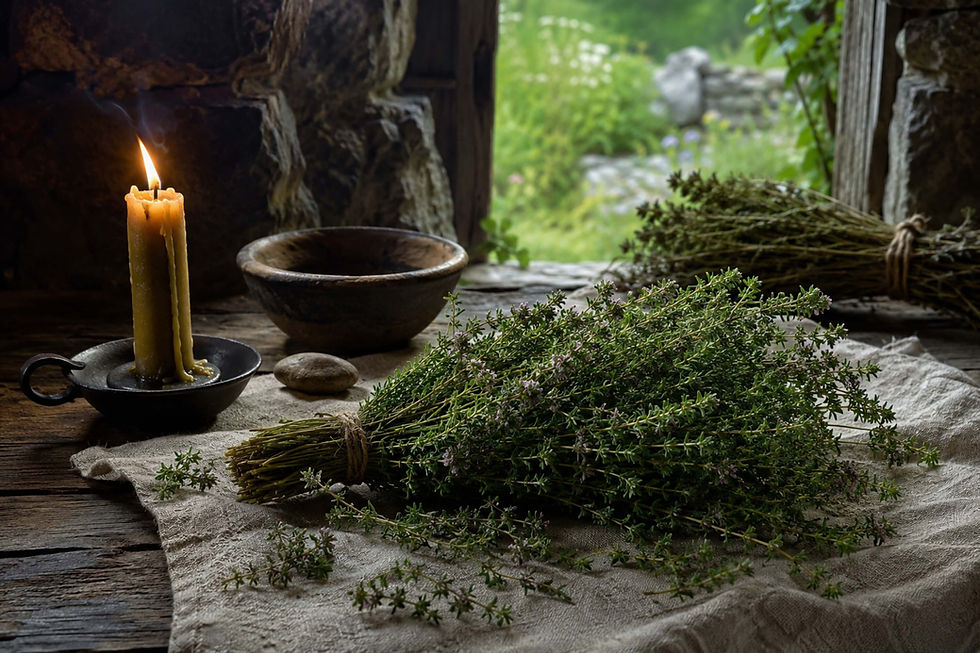
Yarrow and the Wisdom of Mending — Herbal Wisdom
- Sorcha Lunaris

- Apr 9
- 11 min read
“What is gently gathered can become strong again.”
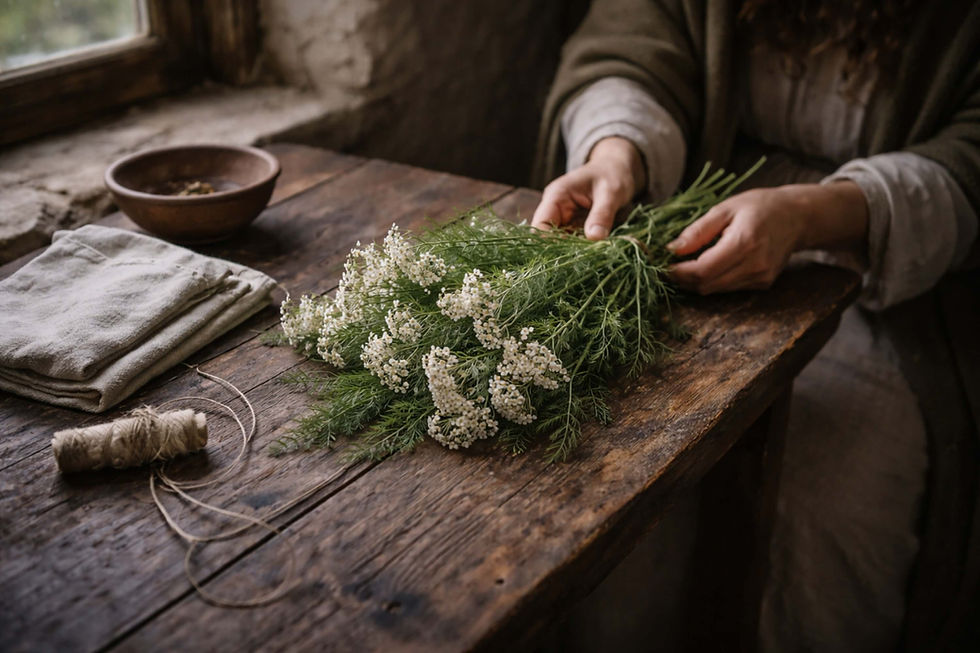
Some herbs remain in memory not because they are rare, beautiful, or wrapped in elaborate folklore, but because they proved themselves useful over time. Yarrow belongs to that older company of plants. Its reputation was shaped through handling, need, and repeated practical use rather than through ornament alone. For a very long time, it was associated in traditional herbal practice with wounds, bleeding, and the effort to draw together what had been opened. That gives the plant a particular kind of authority. It is the authority of usefulness, of being turned to when something has been cut, strained, or made vulnerable. In older worlds of household knowledge, this mattered deeply. A plant did not need to be exotic to be honoured. It needed to be dependable. Yarrow came to be remembered in precisely that way: as a herb whose value was closely tied to mending, steadiness, and practical response.
In Irish folk tradition, as in many older herbal cultures, plants were rarely known only as objects of beauty or symbols in the abstract. They were encountered through use, season, place, and lived need. Their meanings gathered around what they were observed to do, how they behaved in the landscape, and what role they played in the rhythm of tending life. Yarrow’s long-standing reputation as a herb connected with staunching and repair places it firmly within that wider pattern of practical plant respect. This is not the same as claiming one fixed ancient Irish rite around it, nor should its story be simplified into that kind of certainty. It is better understood as part of a broader body of traditional herbal regard. The herb became memorable because it answered something real. It stood close to the enduring human need to stop loss, support repair, and help restore what had been opened.
That practical history gives yarrow a deeper layer of meaning for the witch as well. Within a contemporary Irish witchcraft path, a plant’s older use can become more than historical information. It can become a form of teaching. Yarrow speaks not only of physical tending in the older herbal sense, but of the moment in life when something has been worn thin and needs to be drawn back into form. There are seasons when the work is not expansion, openness, or further reaching. There are seasons when the wiser task is mending. Something has been overextended, frayed, or left too exposed, and the next truthful act is not to push harder, but to begin gathering what has been scattered. In that way, yarrow becomes a plant of discernment. It reminds the spirit that repair has its own intelligence, and that containment can sometimes be the beginning of renewed strength.
This is part of why the wisdom of yarrow still feels relevant even outside direct herbal use. The plant carries a quiet reminder that not every difficulty is met through endurance alone. Sometimes what is needed first is to stop the loss, recognise the breach, and tend carefully to what has been weakened. In lived practice, that can be a difficult lesson. There is often pressure to continue, to expose more, to keep proving resilience by remaining open long after steadiness has started to fail. Yet older plant wisdom is often less impressed by performance than by survival. What has been cut may need binding. What has been drained may need holding. What has been stretched too far may need to be brought inward again before it can truly strengthen. Yarrow stands close to that understanding. It teaches that mending is not retreat from life, but one of the ways life is faithfully restored.
What Older Herbal Memory Still Teaches
One of the most valuable things about traditional plant knowledge is that it often preserves a relationship between use and meaning. A herb was not respected only because it looked striking in the field or because it gathered poetic associations around itself, though those things may also have mattered. It was respected because people turned to it in real conditions of need and remembered what happened. Yarrow carries that kind of memory strongly. Its long-standing association with wounds, bleeding, and the drawing together of what has been opened gave it a reputation shaped through practical regard rather than sentimental affection. This matters because it keeps the plant rooted in the serious world of tending life. It was not merely admired. It was relied upon. In that reliance, a deeper wisdom gathered around it, one that still speaks clearly even when the language of use is being approached more reflectively today.
That older memory also protects the herb from becoming too vague in spiritual interpretation. It is easy in modern practice to speak about plants only in broad symbolic tones, as though each herb exists chiefly to reflect a mood or a feeling. Yet plant wisdom becomes stronger when it remains tethered to something observable and lived. Yarrow does not speak of mending by accident. It speaks of mending because generations remembered it in connection with the work of staunching, binding, and helping what had been opened begin to close. Within a contemporary path, that does not require overclaiming or careless medical certainty. It simply means allowing the plant’s historical character to guide the kind of spiritual reflection drawn from it. In this sense, older herbal memory offers both richness and restraint. It gives meaning, but it also keeps that meaning disciplined by what the plant was actually known for.
For the witch, that discipline can be deeply useful. It reminds us that not every lesson needs to be invented afresh, and that some forms of wisdom have already been tested through repeated human need. Yarrow suggests a particular response to strain: not endless endurance, not dramatic collapse, but careful drawing together. It points toward the moment when enough has already been lost, and the wiser act is to preserve what remains. That may apply to energy, attention, emotion, speech, or the atmosphere of the home just as much as to older herbal logic around bodily injury. The plant’s wisdom can therefore travel without becoming untethered. It moves from practical memory into spiritual insight while still carrying the shape of its original use. That is why it feels so grounded. It does not encourage abstraction for its own sake. It keeps returning us to the simple intelligence of mending what has been breached.
There is a quiet corrective in that. Modern life often praises exposure, speed, and continual movement, as though everything valuable must be stretched further in order to prove its worth. Older plant wisdom tends to be less impressed by that kind of pressure. Yarrow, in particular, stands as a reminder that repair is not secondary to growth. At times, repair is the necessary condition that allows growth to return with integrity later on. What has been frayed at the edges may need gathering. What has been opened may need a careful interval of holding. What has been leaking strength may need the loss to be acknowledged before recovery can begin. In that sense, the herb offers more than historical interest. It offers a pattern of discernment. It teaches that mending is not weakness, hesitation, or retreat. It is a serious and timely response when life has been asked to hold more than it can carry well.
When Mending Is the Wiser Work
There are seasons in life when the deepest need is not for expansion but for repair. This can be difficult to recognise in time, especially when the world around us praises persistence, output, and the ability to keep going regardless of cost. A person may continue reaching outward long after something inward has begun to fray. Energy becomes thinner, patience shorter, and the spirit less able to hold what it once carried with steadiness. Yet not every difficult period calls for greater effort. Some call for discernment. They ask whether what has been opened needs further exposure, or whether it has already reached the point where mending is the truer response. Yarrow speaks strongly to that moment. Its older associations suggest that wisdom does not always lie in pressing on. Sometimes wisdom lies in recognising that enough has already been lost, and that the next faithful act is to begin gathering.
That is part of why the deeper teaching of yarrow feels so relevant beyond its herbal history alone. It reminds the witch that care is not weakness, and that repair is not a lesser form of strength. In lived practice, there can be a temptation to leave every wound open in the name of honesty, as though exposure itself were always the most truthful path. There can also be a habit of treating endurance as more admirable than tenderness, particularly when life has become demanding or spiritually dry. Yet older plant wisdom often teaches a steadier lesson than that. What has been cut may need binding. What has been drained may need holding. What has been disturbed may need quiet rather than constant stimulation. Yarrow belongs to this more measured understanding. It does not glorify collapse, nor does it romanticise pain. It simply reminds us that mending has its own rightful season and its own serious dignity.
Within a contemporary Irish witchcraft path, this can become a meaningful way of reading the rhythms of one’s own life. There are times when the work is to open, seek, and move outward toward new understanding. There are other times when the wiser movement is inward, toward containment, steadiness, and the restoration of what has been strained too long. The difficulty is that these quieter seasons are often easy to misread. A person may think they are failing because they no longer have the same appetite for exposure, striving, or risk. In truth, they may simply be entering a phase where repair is more important than reaching. Yarrow stands close to that threshold of recognition. Its wisdom suggests that strength is not always proven by how much can remain uncovered. Sometimes it is shown by the ability to protect what is still healing until it can return to fuller life without breaking open again.
This kind of discernment asks for patience, because mending rarely satisfies the impatient part of the self. Repair can look small from the outside. It may involve fewer dramatic gestures, less visible movement, and a quieter kind of progress than the world tends to praise. Even so, it often carries deeper consequence. What is carefully drawn together can recover its integrity in ways that constant pushing never allows. What is given time to close can regain strength without becoming hardened. Yarrow’s older memory holds that truth with unusual clarity. It teaches that life is not always asking for more effort, more openness, or more proving. Sometimes it is asking for the loss to be stopped, for the frayed edges to be respected, and for what has been weakened to be gathered back toward centre with care. That is not withdrawal from the work of living. Very often, it is what makes fuller living possible again.
The Strength That Returns Through Care
One of the quieter lessons carried by yarrow is that restoration does not begin only once everything feels whole again. It often begins at the earlier moment when the breach is finally recognised for what it is. Something has been cut, strained, drained, or worn too thin, and pretending otherwise no longer protects anyone. This is where the wisdom of mending becomes more than sentiment. It becomes practical discernment. Older herbal understanding did not value yarrow because it was decorative or abstractly symbolic. It was valued because it belonged to the work of responding when something had opened and needed help to come back into form. That same pattern still speaks clearly now. Strength is not always regained by continuing unchanged. Sometimes it returns through the more modest but more truthful act of acknowledging the loss, stopping what worsens it, and tending what remains with steadier hands.
For the witch, this offers a meaningful correction to the habit of treating care as secondary to endurance. Endurance has its place, and there are times when life genuinely asks for resilience. Yet resilience without tending can become another name for depletion. A person may pride themselves on carrying on while quietly becoming less able to hold what truly matters. In that state, the desire to appear strong can begin to work against actual strength. Yarrow suggests a different order of values. It reminds us that what has been breached deserves attention before it is asked to bear more. What has been drained deserves holding before it is called to give again. This is not indulgence, nor is it weakness dressed in softer language. It is the practical wisdom of knowing that recovery requires form, and that nothing mends well when its frayed edges are continually ignored.
This also reveals why repair should not be mistaken for simple retreat. Mending is not the refusal of life, but a disciplined way of re-entering it more truthfully. When something has been gathered well, it does not return in exactly the same condition as before. It returns with greater coherence. The scattered parts have been called inward. The unnecessary loss has been checked. The pressure to keep exposing what is still vulnerable has been set aside long enough for real strength to re-form. In this sense, yarrow carries a wider spiritual lesson that extends far beyond herbal memory alone. It teaches that care can be active, intelligent, and exacting. To mend well requires attention, timing, and respect for what has actually happened. It asks not for denial, but for a more faithful response to injury than simple stubbornness can ever provide.
That is why the deeper wisdom of yarrow remains so steady. It does not flatter the appetite for endless motion, nor does it encourage the kind of dramatic brokenness that becomes a performance in itself. It stands instead with the quieter truth that what is weakened may still recover, but not by being asked to ignore its own condition. Some seasons are not meant for further opening. They are meant for drawing together. Some losses are not corrected by speed, but by careful stopping, holding, and patient restoration. When that is understood, mending becomes easier to honour as real work rather than as a pause between more impressive efforts. Yarrow keeps that understanding close. It reminds the spirit that what is gently gathered is not made lesser by the act of gathering. Very often, it is made capable of becoming strong again in a truer and more lasting way.
Blessing of Gentle Mending
"What has been frayed, I gather near,
What has been drained, I hold sincere.
By patient care, my strength shall mend,
And rise more whole where cuts now end."
Closing Wisdom
Yarrow carries a kind of authority that does not need to announce itself loudly. It comes from long memory, from practical use, and from the repeated human recognition that some moments in life require mending more than motion. That is part of what makes the herb so enduring in both herbal thought and spiritual reflection. It does not speak first of expansion, exposure, or endless proving. It speaks of the point at which enough has already been lost, and the wiser act is to draw what remains back toward steadiness. In that sense, its deeper wisdom is not only about physical tending in older tradition. It is also about discernment. It reminds the witch that not every season is asking to be pushed through, and that care is sometimes the most serious form of strength.
There is something quietly corrective in that. A life shaped by real practice cannot be sustained by endurance alone, because endurance without tenderness eventually becomes another form of depletion. What has been cut may need binding. What has been drained may need holding. What has been stretched too far may need to be gathered before it can return to fuller life with integrity. Yarrow stands close to this older understanding and keeps it plain. It teaches that repair is not a lesser task than growth. Very often, it is the condition that allows growth to become truthful again. To mend well is not to withdraw from life, but to honour the form in which life can continue without losing itself further.
In The Ancient Irish Craft, we remember:
What is gently gathered can become strong again.
Carry the Work More Fully
As your relationship with the Craft deepens, you may feel drawn toward greater continuity and deeper work.
The Craft Guides
A practical path of steady Craft work through focused PDF guides, where hearth, home, protection, seasonal practice, folk magic, and daily ritual are made clear, grounded, and easy to return to.
Craft Teachings
A deeper path of study and practice through printable Craft Teachings, where focused subjects are explored with fuller context, ritual understanding, reflection, and grounded ways to carry the Craft into lived practice.
Wherever you stand within the Craft, the path continues inward.
Many blessings to you and yours,
Sorcha Lunaris
Keeper of The Ancient Craft.
Want to read more?
Subscribe to theancientirishcraft.com to keep reading this exclusive post.